The Palio di Siena: 90 Seconds of Glorious Medieval Madness
Ten horses. Seventeen neighborhoods. Nearly 400 years of grudges. And a trophy that is, quite literally, a painted piece of cloth. Welcome to the greatest show in Italy.
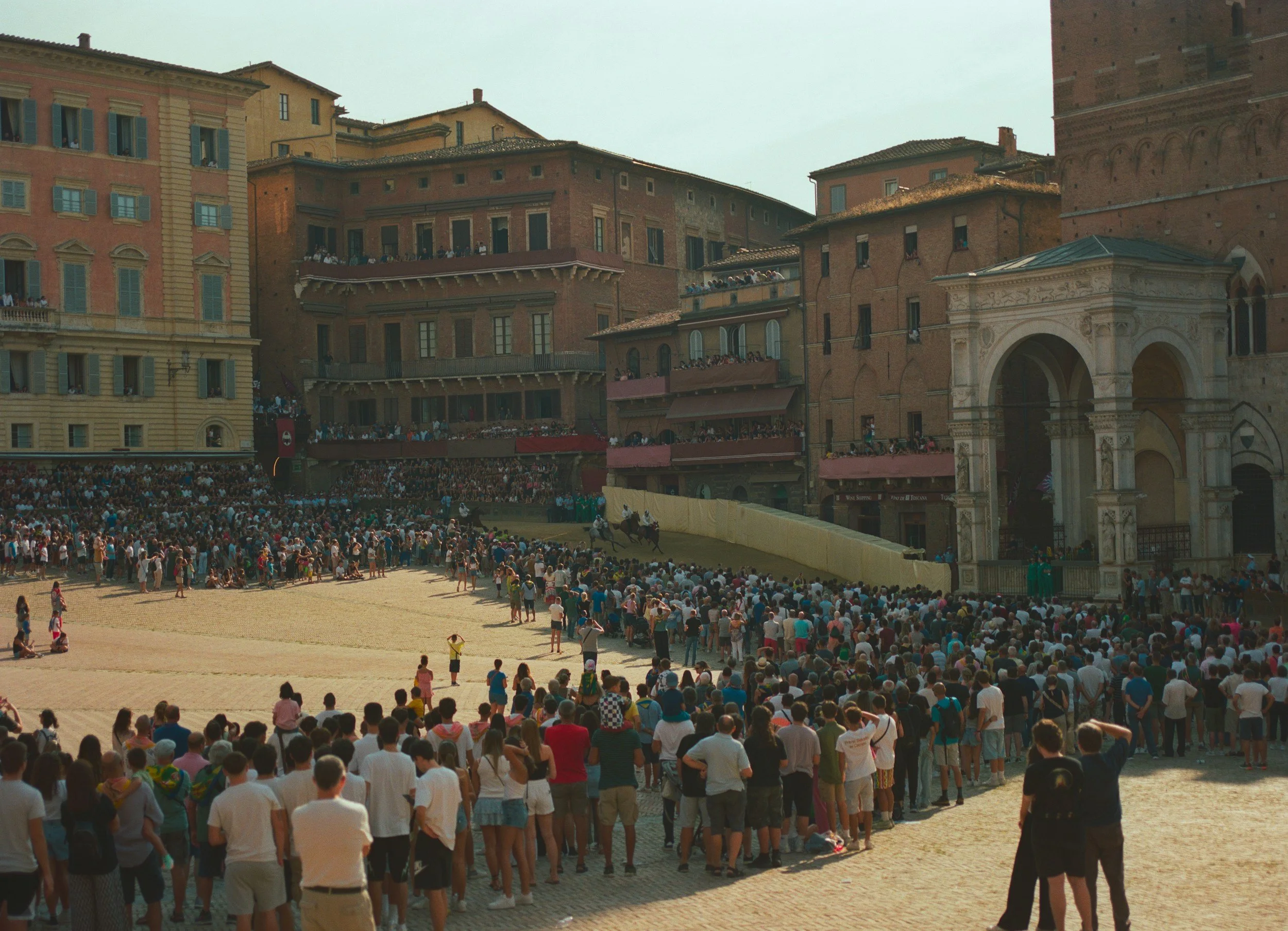
Every summer, twice a summer, the most beautiful square in Tuscany fills with dirt. On purpose. Truckloads of golden earth are laid over the stones of Siena’s shell-shaped Piazza del Campo, mattresses are strapped to the sharpest corners, and 40,000 people cram themselves shoulder-to-shoulder under the Tuscan sun to watch a horse race that lasts about as long as it takes to reheat your coffee.
And yet nobody — nobody — who has stood in that square as the starting rope drops has ever called it “just a horse race.” The Palio is a civic religion, a family feud, an opera, and a street party that has been running on pure adrenaline since 1633.
So What Exactly Is the Palio?
Siena is divided into seventeen contrade — ancient neighborhoods, each with its own name, colors, flag, church, museum, anthem, fountain, and mascot. And what mascots: the Goose, the She-Wolf, the Caterpillar, the Snail, the Dragon, the Unicorn, the Porcupine, the Tower, the Wave. You are born into your contrada, baptized into it (there’s a second, contrada baptism at the neighborhood fountain), and you will root for it until your dying breath.
Twice a year — July 2 and August 16 — ten of the seventeen contrade race horses around the Piazza del Campo, bareback, for three hair-raising laps. The July race honors the Madonna of Provenzano; the August race, the Madonna of the Assumption. The winner receives the drappellone: a hand-painted silk banner, commissioned from a different artist each time, which the Sienese affectionately call il cencio — “the rag.” People weep over the rag. Grown adults kiss the rag.
A Little History (Featuring Banned Bullfights and Buffalo)
Siena’s piazza has hosted public spectacles since the Middle Ages — jousts, boxing free-for-alls, and bullfights. When the Grand Duke of Tuscany banned bullfighting in 1590, the contrade needed a new outlet for their competitive energy and briefly settled on… buffalo races. Then donkey races. Eventually someone had the good sense to put horses back in the picture, and in 1633 the first Palio “alla tonda” — round the square — was run. The August race joined the calendar in 1701.
In 1729 the city fixed the contrade boundaries and capped each race at ten runners, because — and this is the official reason — there had been too many accidents. That rule, like nearly everything else about the Palio, has not changed since. The Sienese have run this race through plague, war, and empire. When Napoleon came and went, the Palio stayed. They even ran a special edition in 1969 to celebrate the Moon landing, because if humanity does something remarkable, Siena’s natural response is a horse race.
The Best Week of the Year: What Actually Happens
Here’s the secret the highlight reels don’t tell you: the race is 90 seconds, but the festival is four days — and the plotting lasts all year.
The horse lottery (la Tratta). Three days before the race, ten roughly equal horses are assigned to the ten contrade by random draw, in the piazza, in front of everyone. This is pure theater: a contrada that draws a champion erupts like it’s already won; one that draws a slowpoke goes into public mourning. The contrade don’t own the horses — fate hands them out. It’s the world’s highest-stakes raffle.
The trial races (le Prove). Six practice runs over three days, each one drawing crowds, each one an excuse to size up rivals, sing rude songs at them, and adjust strategy. Alliances are made, favors promised, and jockeys negotiate deals of breathtaking complexity right up to the starting rope.
The contrada dinner. The night before the race, each contrada throws an open-air feast for a thousand-plus people at long tables snaking down its streets — wine, pasta, speeches, and songs until late. The jockey sits at the head table and everyone stares at him wondering if he’ll betray them. (It has happened. It is always remembered.)
The blessing of the horse. On race day, each horse is led inside its contrada’s church, where a priest blesses it and sends it off with the traditional words: “Vai e torna vincitore” — “Go, and return a winner.” If the horse leaves a little souvenir on the church floor, that’s considered excellent luck. This is a real thing that really happens in a consecrated building.
The Corteo Storico. Before the race, a two-hour historical pageant circles the track: hundreds of participants in full Renaissance costume, drummers, trumpeters, and the alfieri — flag-throwers who launch silk banners spinning into the sky in perfect synchrony. By the time the horses appear, the entire piazza is vibrating.
The Race: Rules? What Rules?
Let’s review the regulations, such as they are. The jockeys ride bareback. They carry whips made of stretched ox hide, which they may use on their own horse or on each other. Shoving is fine. Grabbing is fine. Ambushing a rival at the start because his contrada is your sworn enemy is not just fine — it’s expected.
The start alone (la mossa) is a psychological thriller. Nine horses line up between two ropes in an order drawn by lot; the tenth, the rincorsa, hangs back and decides when to charge in — which is the moment the race begins. Except he won’t charge until the alignment favors his friends and ruins his enemies, so the start can take the better part of an hour of feints, false starts and 40,000 people collectively losing their minds.
Then the rope drops, and for three laps — about 90 seconds — the piazza becomes a cauldron. The corner at San Martino drops downhill and turns hard; jockeys regularly go flying. And here’s the most Sienese rule of all: the horse doesn’t need its rider to win. A riderless horse (cavallo scosso) that crosses the line first takes the whole thing, and the contrada celebrates the horse like a returning general.
A few more Palio truths that sound made up (but aren’t): the real loser isn’t whoever finishes last — it’s whoever finishes second. If your archrival loses, you celebrate almost as hard as if you’d won. The contrada that’s gone longest without a win is mockingly called la nonna — “the grandma.” And the winners throw months of celebrations, including a victory dinner where the guest of honor is the horse.
Why You Need to See It Once in Your Life
Because nothing else on Earth is like it. The Palio isn’t a re-enactment or a show put on for visitors — there’s no admission fee, no sponsor banners, no halftime entertainment. It’s a living piece of the Middle Ages that the Sienese perform for themselves, exactly as their great-great-great-(keep going)-grandparents did, and you’re simply invited to stand inside it.
You’ll feel the ground shake through your shoes. You’ll watch a grown man cry into a flag. You’ll hear an entire neighborhood sing at midnight over plates of pici pasta. And 90 seconds of racing will deliver more drama than most entire sports seasons — betrayal, redemption, ecstasy, heartbreak — all before dinner.
Bucket lists were invented for exactly this.
See the Palio in 2027 — The Right Way
The 2027 races run July 2 (Palio di Provenzano, festival days June 29-July 2) and August 16 (Palio dell’Assunta, festival days August 13-16). Balcony and window seats overlooking the track sell out many months — sometimes years — in advance.
We’re building a limited, high-level Palio 2027 package: premium balcony viewing over the Piazza del Campo, an insider contrada dinner, private guides who know the backstreets and the backstories, and handpicked Tuscan accommodations.
Contact us today to reserve your spot for the Palio 2027 — and see the greatest 90 seconds in Italy from the best seat in the square.